Cost is almost always the first thing people want to know, and it’s also the hardest question to answer with a single number. The honest answer is that custom t-shirt printing pricing in Singapore sits on a sliding scale, and where you land on that scale depends far less on the shirt itself and far more on the decisions you make about your design, your quantity, and your printing method.
Here’s a practical breakdown of what actually drives the price, so you can estimate your own order with reasonable accuracy before you request a quote.
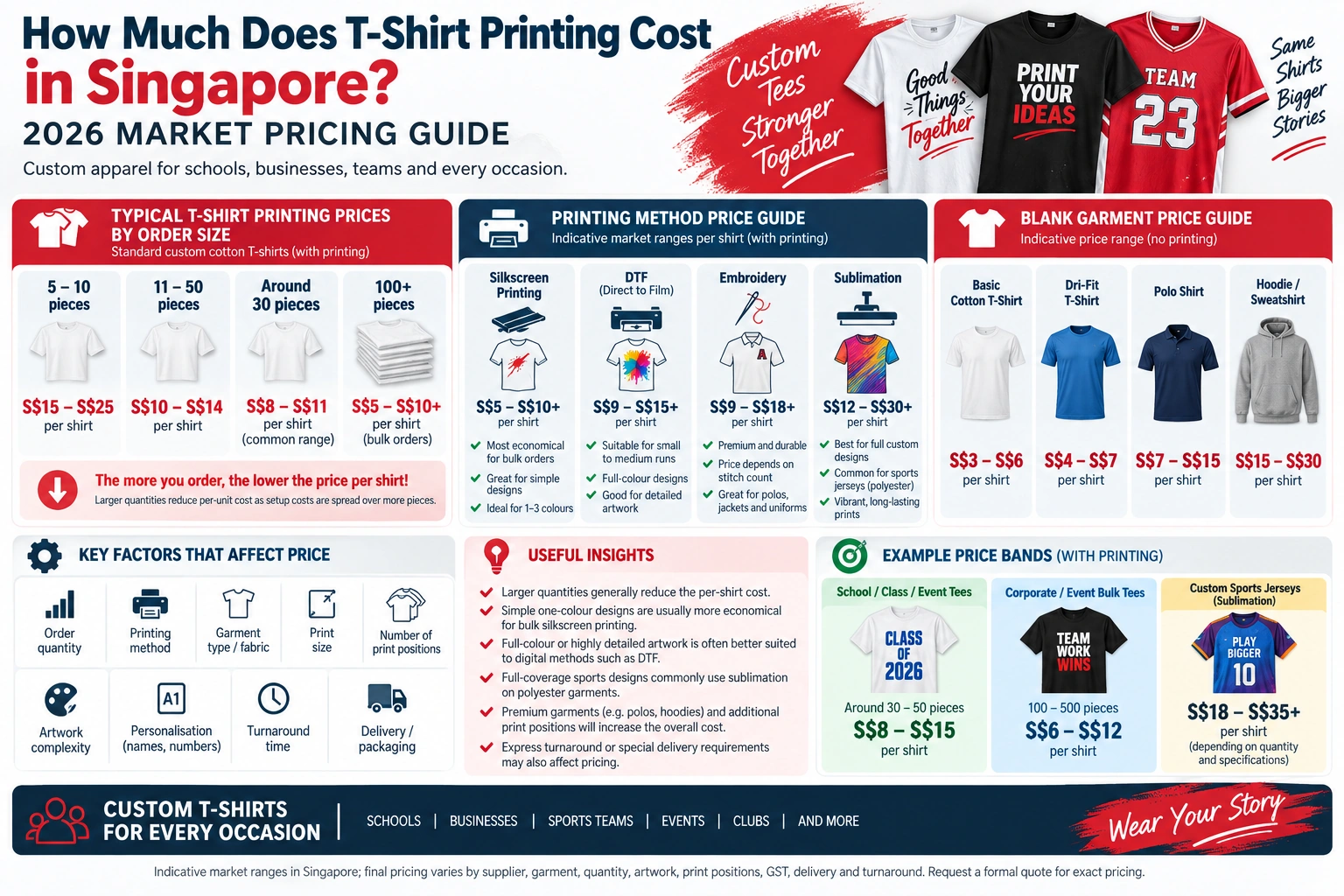
What Actually Determines Your Price
Most people assume the shirt is the main cost. In reality, the blank garment is often the smaller part of the total. The bigger variables are these:
- Quantity ordered. Per-unit pricing drops significantly as volume goes up. Setup costs, especially for screen printing, get spread across the whole order, so 200 shirts can cost noticeably less per piece than 20.
- Number of print locations. A front-only print is the cheapest option. Adding a back print, then sleeves, then a chest pocket area, increases cost with each location.
- Number of colors in your design. Each color in a screen print typically requires its own screen and setup. A one-color logo is dramatically cheaper than a four-color gradient design.
- Printing method. Screen printing, direct-to-garment, heat transfer, embroidery, and sublimation all carry very different price points.
- Fabric and garment quality. A basic cotton tee costs less than a premium ring-spun cotton or a performance dri-fit blend.
- Turnaround time. Rush and expedited orders carry a premium, since they move ahead of scheduled production.
Rough Price Ranges by Order Type
While exact quotes vary by vendor and specification, here’s how orders generally cluster in Singapore.
Small Personal Orders (1 to 10 Pieces)
This is the most expensive tier on a per-shirt basis. Setup costs can’t be spread out, so single custom shirts or small batches for gifts, birthdays, or personal projects usually carry a much higher unit price. Digital printing or heat transfer is typically used here since screen printing setup isn’t economical at this volume.
Mid-Size Orders (20 to 100 Pieces)
This is the sweet spot for most small businesses, school groups, CCA teams, and small corporate events. Per-unit pricing drops meaningfully here, and screen printing becomes viable for simple designs. A single-color front print in this range is usually the most cost-effective combination available.
Bulk Orders (100 Pieces and Above)
This is where per-shirt pricing becomes genuinely competitive. Large corporate events, conferences, and giveaway campaigns fall here. If your design is simple and your quantity is high, this tier delivers the lowest cost per shirt by a wide margin.
Where Most People Accidentally Inflate Their Own Costs
In our experience, the single most common way organizers overspend is by over-designing. A brief that asks for a logo on the front, a slogan on the back, sponsor names on both sleeves, and four colors throughout will cost multiples of a simple, bold single-location print, without necessarily looking better.
The counterintuitive advice we give most often is this: go bigger on fewer sides. A large, confident front print reads more strongly across a room than four small prints scattered over the garment, and it costs a fraction of the price.
The second common cost trap is submitting an unfinished brief. When designs and quantities aren’t locked in before requesting a quote, the back-and-forth adds days to the timeline. For anyone with a fixed event date, that delay is what pushes an order into rush pricing territory.

Premium Options and When They’re Worth It
Not every order should be optimized purely for cost. Higher-end methods like embroidery and sublimation cost more per piece, but they’re worth considering in specific situations.
Embroidery holds its shape and color far longer than flat prints, which makes it the better investment for shirts intended for repeated wear, such as staff uniforms or garments for senior leadership and VIP recipients. Sublimation works well for all-over designs and performance fabrics where a printed layer would feel heavy or crack over time.
The useful question isn’t “what’s cheapest,” it’s “who is wearing this, and for how long?” A shirt worn once at a single-day event rarely justifies premium methods. A shirt representing your brand in client meetings for two years absolutely does.
The Hidden Cost Nobody Budgets For
There’s one expense that doesn’t appear on any quote: the reprint.
Colors displayed on a screen rarely match exactly how ink appears on fabric. Monitors vary in brightness and color calibration, and printing equipment interprets color differently again. A shade that looks perfect on your laptop can come out noticeably off on cotton.
For any order where brand colors matter, checking a physical color chart or a printed sample before committing to a full run is the cheapest insurance you can buy. Reprinting 200 shirts because the blue came out wrong costs vastly more than the twenty minutes it takes to verify a shade in person.
How to Get an Accurate Quote Quickly
If you want a realistic number fast, come prepared with these five details:
- Total quantity needed
- Number of print locations
- Number of colors in the design
- Fabric or garment preference
- Your firm deadline
With those specifics in hand, any reputable t shirt printing vendor can give you a genuine quote rather than a vague range. Without them, you’ll get an estimate that changes the moment your actual design arrives.
The Bottom Line
Custom t-shirt printing in Singapore can be remarkably affordable or surprisingly expensive, and the difference usually comes down to choices you control. Simplify your design, order in the largest quantity you realistically need, confirm your colors physically, and finalize your brief before asking for pricing. Do those four things and you’ll almost always land at the lower end of whatever range applies to your order.
Frequently Asked Questions
Is it cheaper to print more colors or more locations on a shirt?
Neither, both increase cost, so reducing colors and print locations together gives the biggest savings.
Does ordering more shirts really lower the price per shirt?
Yes, setup costs get spread across the order, so larger quantities significantly reduce per-unit pricing.